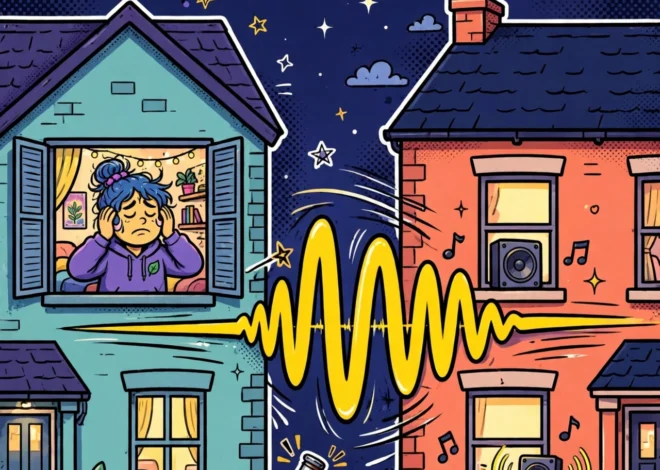
How to Block Noise From a Neighbour’s Heat Pump
Short answer: To block noise from a neighbour’s heat pump, put a solid barrier between the unit and your home that fully breaks the line of sight, keep it close to the unit or close to your listening position, and leave the airflow around the unit untouched. A solid fence, wall or acoustic screen works because it blocks the direct path of the sound. A thin fence, a hedge on its own, or a cover draped over the unit does not. If the sound is a low hum felt indoors rather than heard outdoors, a barrier may help far less, and the fix is more likely to be at the unit itself, through servicing, anti-vibration mounts, or a quiet mode setting agreed with your neighbour.
This guide is the practical companion to yesterday’s dispute guide. Yesterday’s article covered what to do when a neighbour’s heat pump is too loud: talk first, keep a diary, and ask environmental health to investigate if needed. This article covers the physical side: what actually blocks the sound, what wastes money, and what you must not do to someone else’s equipment. You cannot alter, cover, or move a heat pump that is not yours. Everything here that touches the unit itself needs your neighbour’s agreement and, in most cases, their installer.
Why a barrier works, and why line of sight matters most
Sound from a heat pump travels in a direct line from the fan and compressor to your ears, and it also bounces off hard surfaces such as walls, patios, and fences. A barrier helps by breaking that direct line and by absorbing or reflecting some of the sound before it reaches you. That is why the single most useful test is a simple one: stand where the noise bothers you most, usually a bedroom window or a patio seat, and look towards the unit. If you can see the top of the unit over the barrier, the barrier is doing far less than it could. If the barrier fully hides the unit from that spot, you are in the best position a barrier can give you.
The MCS 020 planning calculation, which installers use to check heat pump noise under permitted development, puts numbers on this. In that method a solid barrier that fully obscures the assessment position from the top of the unit earns a 10 decibel allowance, a barrier that leaves a partial view earns 5 decibels, and a barrier with a full view earns nothing. The barrier must be solid: the method distinguishes a barrier at least 18 millimetres thick from a thinner solid barrier, which earns half as much. A 10 decibel reduction is a large change in perceived loudness, roughly halving how loud the sound feels, but it is an allowance inside a planning calculation, not a promise that your garden will measure 10 decibels quieter. Real results depend on the unit, the distance, the ground, and the surfaces around it.
Distance helps too, and it helps predictably. In the same MCS method, doubling the distance from the unit removes about 6 decibels. That is why a barrier close to the unit, or close to your window, usually beats a barrier halfway across a garden: the closer the barrier sits to the source or to the listener, the larger the shadow it casts over the listening position. A barrier that stands in open ground with clear gaps around its sides lets sound flow round its edges, so keep the sides tight and the base sealed. Gaps under a fence, missing boards, and open gates all leak sound, and they leak it at exactly the frequencies you most want to stop.
What to build: solid, heavy, gap free, and tall enough
The most reliable options are all versions of the same idea: a solid, heavy barrier with no gaps, tall enough to break the line of sight from the places where you actually listen.
A solid fence or wall. A close-boarded timber fence, a brick wall, or a concrete panel wall will do the job if the boards are tight, the panels overlap, and there are no gaps at the base. Featherboard fencing with visible gaps between boards is a poor sound barrier, however smart it looks, because sound passes straight through the slits. If you already have a gappy fence, fixing the gaps with overlapping boards or a solid backing board is often the cheapest real improvement you can make. Weight matters as well: a heavier barrier blocks more sound than a light one, which is why masonry outperforms a thin timber screen of the same height.
An acoustic fence or acoustic screen. Acoustic fencing is a purpose built version of the same idea: a solid panel, often timber faced over a dense mineral wool core, designed to absorb sound on the side facing the unit as well as block it. These panels are sold as garden fencing and as free standing screens, and they suit the spot between a heat pump and a boundary where a full new fence is not wanted. The same rules apply: no gaps, a solid base, and a height that breaks the line of sight. Check the product’s stated performance with care, because suppliers measure in different ways, and a headline figure measured in a laboratory will not be the figure you get in a real garden.
A purpose built acoustic enclosure. An enclosure is a screen that wraps around the unit on several sides, usually with an open top or louvred panels to keep air moving. This is the option with the highest potential benefit and the highest risk of getting it wrong, because a heat pump needs a constant flow of air. Air is drawn in at the back and sides and blown out at the front, so any enclosure must keep the manufacturer’s clearances, keep the discharge path open, and keep access for servicing. A box that chokes the airflow will make the unit work harder, run louder, and in some cases shut down or break down. For that reason an enclosure should be designed with the installer, not improvised, and it should never be fitted to a neighbour’s unit without their agreement.
Whichever barrier you choose, the height is constrained by planning rules. In England, a garden fence, wall, or gate can usually be built up to 2 metres high without planning permission, dropping to 1 metre where it stands next to a highway used by vehicles or the footpath of such a highway. Those are the usual permitted development thresholds, not a maximum height: a taller barrier can be proposed with a planning application, and listed buildings, conservation areas, Article 4 directions, and planning conditions can remove or change the usual rights. Scotland, Wales, and Northern Ireland have their own planning systems, so check with the local council before assuming the English figures apply. A barrier that needs planning permission is still worth proposing if the noise justifies it, but it is a poor surprise to discover the rule after the posts are in.
What does not block heat pump noise well
Hedges and planting alone. A dense hedge softens a garden and can make a noise feel less intrusive, but leaves and thin branches do not block sound in any measurable way. A hedge in front of a solid fence is a pleasant addition. A hedge instead of a solid fence is not a sound barrier. If you love the hedge, keep it, but do not budget for it as noise control.
Thin screens, trellis, and decorative panels. Anything you can see through will let sound through. Trellis, slatted screens, and willow hurdles look like barriers and behave like open air. The same applies to a fence with gaps for climbing plants: the plants are decoration, and the gaps are the problem.
Covering or boxing in the unit. Never drape a cover, tarpaulin, blanket, or board over a running heat pump, and never fit a tight box around it. Acoustic specialists warn that a cover that blocks airflow makes the unit work harder, which can increase the noise, reduce efficiency, and damage the unit. Some suppliers sell covers meant only for protection while the unit is switched off, which is a different product for a different job. While the unit is running, air must flow freely.
Barriers for a low frequency hum. This is the hardest case, and honesty matters here. Heat pump noise has two parts: the broadband fan noise that a barrier handles well, and a low frequency hum from the compressor that travels through the ground and through building structures. Acoustic specialists note that ordinary barriers and enclosures are rarely effective against low frequency tonal noise, and that an enclosure can even amplify a hum heard inside an adjoining building. If the problem is a hum you feel through a wall or floor at night, rather than a fan sound you hear in the garden, a fence is unlikely to solve it. That case points back to the unit: vibration isolation, flexible pipe connections, compressor mounts, and servicing, all of which need the owner’s installer.
What you can do on your own side of the boundary
Everything in this section is yours to decide, without touching your neighbour’s property or equipment.
Fix your own fence first. If the boundary fence is yours, or if your neighbour agrees to a shared improvement, seal the gaps, overlap the boards, and make sure the base meets the ground. If the fence is your neighbour’s, offer to share the cost of the improvement: a neighbour who will not pay for a new fence may still agree to one they do not have to fund alone. Put any cost sharing in writing, briefly, so the agreement survives a change of ownership or a change of mood.
Add acoustic panels on your side. Outdoor acoustic panels or sound absorbing blankets fixed to your side of a solid fence can reduce reflections off the fence face and take a little more edge off the sound. They work best as a supplement to a solid barrier, not as a replacement for one. A blanket hung on a gappy fence still has a gappy fence behind it. Keep panels clear of the unit itself and clear of any shared boundary rules in your deeds.
Seal the sound paths into your home. Sound that reaches your house gets in through gaps before it gets through walls. Check window and door seals, letterboxes, trickle vents, and extractor fan outlets in the rooms where the noise bothers you most. Weatherstripping and draught seals are cheap, and they help with heat loss at the same time. Secondary glazing or triple glazing helps more, but it is a bigger spend, so treat it as a later step if a barrier and sealing have not done enough. Heavy curtains and rugs absorb a little sound inside a room, and they are worth having, but they will not fix a noise that is loud outdoors.
Mask the sound at night, as a stopgap. A white noise machine or a fan in the bedroom can make a steady hum less noticeable while longer fixes are arranged. This is a coping measure, not a solution, and it should not be the end of the story if the noise is genuinely disrupting sleep. Note it as a stopgap in any diary you keep, because it shows the effect the noise is having, which matters if the case ever reaches environmental health.
Move the listening position, if you can. It sounds trivial, but sleeping in a room on the far side of the house, or moving a patio seat behind a solid outbuilding, uses the same line of sight rule as a barrier. A garage, shed, or solid garden wall between the unit and your seat is already a barrier, and it costs nothing. This is not a fair long term answer to someone else’s noise, but it is a useful test: if the noise vanishes behind an outbuilding, a barrier in the right place will probably help a lot.
What to ask your neighbour, in order of cost
The cheapest fixes of all sit on your neighbour’s side, and they are worth asking for politely before you spend money on a fence. Frame the request as a shared problem with a cheap first step, not as a demand.
Quiet mode and night scheduling. Many modern heat pumps have a quiet mode or a night mode that slows the fan and compressor, trading a little output for a quieter run. One manufacturer’s published example, Panasonic’s Aquarea range, quotes a further 4 decibel reduction in quiet mode at full load conditions, which shows the scale of what a setting change can do, though the figure will differ by model. Ask whether the unit has such a mode and whether it can be scheduled for the hours when the noise bothers you most. If the unit is oversized for the house, quiet mode may cost nothing in comfort at all.
A service and a check of the mounts. A unit that has grown louder often has a simple cause: a loose panel, a worn anti-vibration mount, debris in the fan, or a compressor mount that has hardened with age. A service by the installer, with the mounts and fixings checked, is a normal maintenance cost for the owner and a reasonable request from a neighbour. Vibration that reaches your home through the ground or through shared pipework points to mounts and flexible connections, which only the owner’s installer can properly address.
Repositioning or screening by the owner. Moving a unit further from a boundary, or fitting an acoustic screen on the owner’s side, is a bigger job, but it is the fix that best matches the physics: a barrier close to the source casts the largest shadow. If the unit was installed under permitted development, any move or screen should be checked against the MCS 020 calculation again, because moving the unit changes the distance and the reflecting surfaces, and a move that looks helpful can change the planning position. The owner, not you, should commission that check.
Do not offer to pay for work on a neighbour’s unit without a written agreement about who owns the work, who maintains it, and what happens if it does not help. A generous offer that is undocumented can become a second dispute.
The order to do things in
Start free, then cheap, then structural, and keep a note of what each step changed.
First, confirm what you are hearing and when. Stand at the listening position, check the line of sight, and note whether the noise is a fan sound outdoors, a hum indoors, or both. That one observation decides whether a barrier is even the right tool.
Second, talk to your neighbour and ask about quiet mode and servicing. These cost little or nothing and solve a surprising share of cases.
Third, seal gaps in your own fence and in your windows and doors. This is low cost, it helps with draughts and heat loss too, and it removes the leaks that undermine a later barrier.
Fourth, build or upgrade the solid barrier, at a height within the permitted development limits unless you have decided to apply for permission for a taller one. Build it close to the unit or close to your listening position, with no gaps at the base or sides, and tall enough to hide the unit from the places where you listen.
Fifth, if the noise is still disrupting your home, go back to the steps in yesterday’s guide: keep a dated diary, record the effect on sleep and use of your garden, and ask your council’s environmental health team to investigate. A barrier you have built in good faith strengthens that case, because it shows you tried to help yourself before asking the council to act. If the noise turns out to be a statutory nuisance, the council can require the owner to act, and a barrier, a service, or a quiet mode schedule may be part of what they are required to do.
Frequently asked questions
How much noise can a fence block from a heat pump?
A solid barrier that fully breaks the line of sight earns a 10 decibel allowance in the MCS 020 planning calculation, with 5 decibels for a partial view and nothing for a full view. Real gardens vary, so treat 10 decibels as the planning allowance for a well built solid barrier, not a guaranteed measurement at your window.
Will a hedge block heat pump noise?
No, not on its own. Planting softens a garden and can make noise feel less intrusive, but leaves do not block sound. A hedge works as decoration in front of a solid fence, not as a substitute for one.
Can I build a fence taller than 2 metres to block the noise?
In England you usually need planning permission above 2 metres, or above 1 metre next to a highway used by vehicles or its footpath. A taller barrier is possible with permission, and listed buildings, conservation areas, and planning conditions can change the usual rights, so check with the council first.
Can I cover my neighbour’s heat pump to quieten it?
No. You must not alter, cover, or move a heat pump that is not yours, and covering a running unit blocks the airflow it needs, which can make it louder and damage it. Any enclosure needs the owner’s agreement and their installer’s design.
Why does the fence help outdoors but not the hum indoors?
A barrier blocks airborne fan noise travelling in a direct line. A low frequency compressor hum can travel through the ground and building structure, where a fence has little effect. That case needs work at the unit, such as vibration isolation and servicing, arranged by the owner.
What should I do first, build a fence or talk to my neighbour?
Talk first. Quiet mode, night scheduling, and a service are free or cheap and often solve the problem outright. Build the barrier after that, so you spend money only on the noise that remains.
Sources and further reading
MCS 020 barrier allowances and distance effects, as explained in the MCS 020 heat pump noise calculation: tradecalculator.co.uk heat pump noise calculator. Worked MCS 020 example showing a 10 decibel barrier allowance for a solid barrier obscuring the assessment position: planning application noise assessment (PDF). Why enclosures must preserve airflow, and why low frequency noise resists barriers: Industrial Noise and Vibration Centre, solving heat pump noise complaints. Airflow clearances and why a running unit must never be covered: Ikoustic acoustic enclosure guide for air source heat pumps. Garden fence permitted development heights in England, 2 metres generally and 1 metre next to a highway: Jones Robinson garden fence law guide. Quiet mode example, 4 decibel reduction quoted for one manufacturer’s range: Panasonic Aquarea quiet operation.
Related reading on this site: My Neighbour’s Heat Pump Is Making a Lot of Noise. What Should I Do? (https://greenretrofitguide.com/my-neighbours-heat-pump-is-making-a-lot-of-noise/), Will the Boiler Upgrade Scheme Be Cut in the Autumn Budget? (https://greenretrofitguide.com/will-the-boiler-upgrade-scheme-be-cut-in-the-autumn-budget/), When Does 0% VAT on Heat Pumps End? (https://greenretrofitguide.com/when-does-0-vat-on-heat-pumps-end/)