How Far Away Can You Hear a Heat Pump?
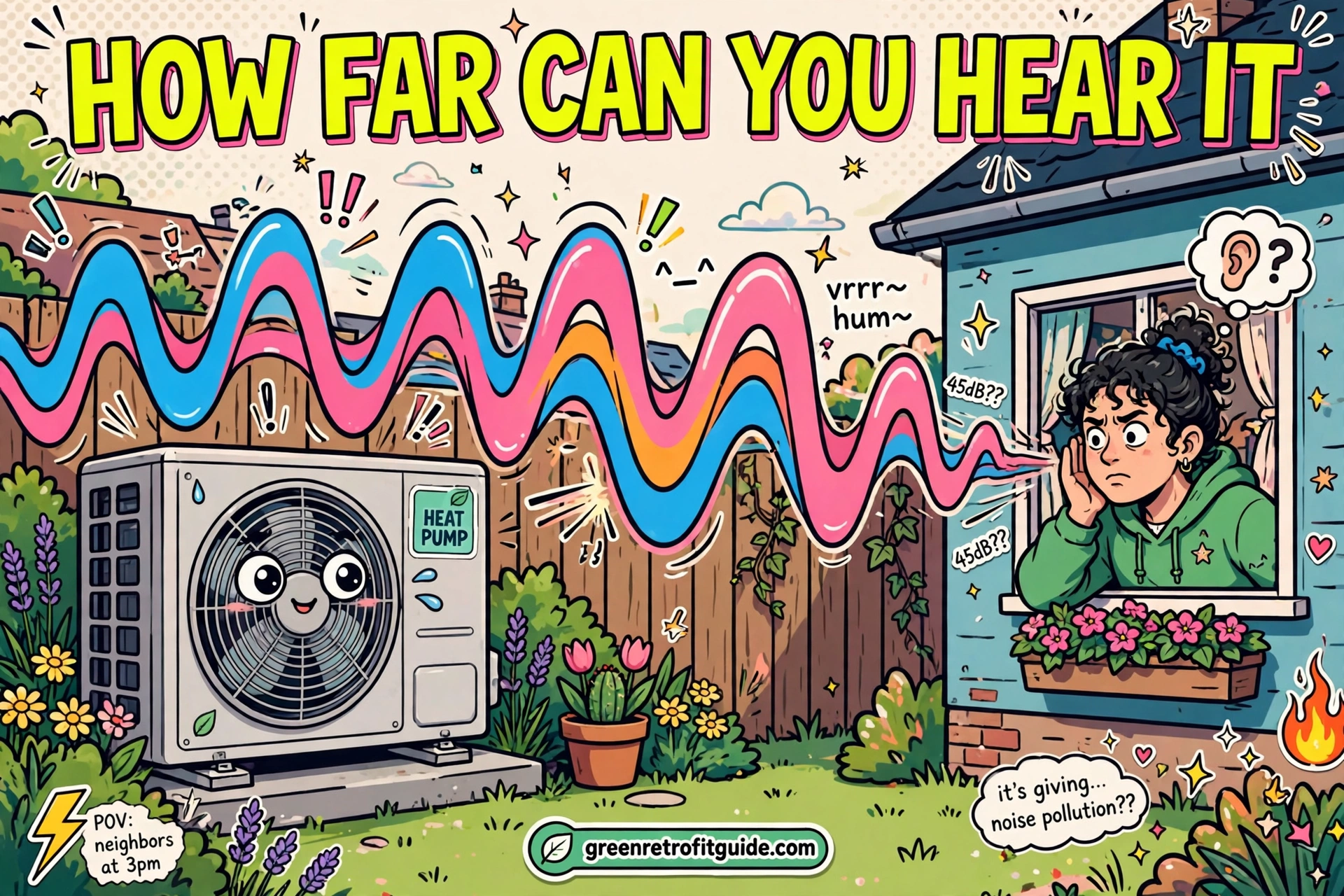
Short answer: How far away can you hear a heat pump depends on three things, not one: how loud the unit is at one metre, how quiet your street already is, and what sits between the unit and your ears. There is no single distance, in metres, that works for every home. A quiet modern unit in a busy street may fade into the background within a few metres. The same unit on a still night in a quiet village, boxed into a corner between two walls, can still be picked out much further away, because the night is quieter, the walls reflect the sound towards you, and a steady hum is easier to notice than a passing car.
This is the fourth article in our heat pump noise series. On Monday we covered what to do when a neighbour’s heat pump is loud. On Tuesday we covered the physical fixes, such as a solid barrier that breaks the line of sight. On Wednesday we covered the legal threshold, and why there is no single decibel number that decides a nuisance complaint. Today we answer the distance question itself: how sound falls away as you move back, what the planning number actually means, and how to estimate what you, or your neighbour, will really hear.
Sound falls by 6 decibels every time you double the distance
The one rule that does hold, in open air, is simple. For a point source such as a heat pump outdoor unit, sound pressure falls by about 6 decibels every time you double the distance from it. This is the inverse square law, and it is the reason a few extra metres matter more than people expect. Doubling from one metre to two metres drops the level by 6 decibels. Doubling again, to four metres, drops it by another 6. The same happens again at eight metres, and again at sixteen.
To see what that means in practice, take a worked example. Suppose a unit measures 50 decibels, written as dB(A), at one metre in open air. That figure sits inside the typical range for modern air source heat pumps, which manufacturers and installer guides commonly put at roughly 40 to 60 dB(A) at one metre, depending on the model and how hard it is working. Apply the doubling rule, with no walls, no fences and no reflections:
- At 1 metre: 50 dB(A)
- At 2 metres: 44 dB(A)
- At 4 metres: 38 dB(A)
- At 8 metres: 32 dB(A)
- At 16 metres: 26 dB(A)
Now take a quieter unit, at 42 dB(A) at one metre, which is a realistic figure for a quiet model running gently:
- At 1 metre: 42 dB(A)
- At 2 metres: 36 dB(A)
- At 4 metres: 30 dB(A)
- At 8 metres: 24 dB(A)
These are illustrative free field figures, not measurements of any particular model. Real gardens have walls, fences, hedges, hard patios and neighbouring houses, all of which change the result, as the next section explains. But the shape of the curve is the point: the first few metres buy you the most. Moving a unit from two metres from a bedroom window to four metres roughly halves the perceived loudness, because a drop of about 10 decibels is generally heard as roughly half as loud. Moving it from sixteen metres to thirty two metres, by contrast, buys the same 6 decibel drop for a far larger change in position, and by then the sound is usually already below the background noise.
Why audibility is about background noise, not just distance
A heat pump does not become inaudible at a fixed distance. It becomes inaudible when it drops below, or blends into, the sound that is already there. That background level changes hugely between places and times of day, which is why the same unit can be unnoticeable in one street and obvious in another.
As a rough guide, typical outdoor levels look like this. A quiet rural area at night, in still air, sits around 30 dB(A). A residential area at night sits around 40 dB(A). A library sits around 35 to 40 dB(A). Normal conversation at one metre sits around 60 dB(A). These are typical values from planning and acoustic guidance, not guarantees for your street, and they vary with wind, traffic, birdsong, rain and the time of year.
Put the two tables together and the distance answer starts to take shape. Against a rural night background of about 30 dB(A), our 50 dB(A) example unit falls to 32 dB(A) at eight metres, still just above the background, and to 26 dB(A) at sixteen metres, below it. Our quieter 42 dB(A) unit reaches 30 dB(A) at four metres and falls below the background soon after. Against a residential night background of about 40 dB(A), the same 50 dB(A) unit falls below the background between two and four metres, at 38 dB(A), and the quieter unit is below it almost immediately.
That is also why complaints cluster at night. During the day, traffic, conversation, lawnmowers and general activity lift the background and mask a steady hum. At night, when the background falls, the same unit stands out, even though it may actually be running more gently. A steady, tonal hum is also easier to notice than a broad, changing sound at the same level, because the ear picks out a constant tone against a quiet background. Low frequency sound, the deep part of a compressor hum, travels well and passes through walls and windows more readily than higher pitched sound, which is another reason a heat pump can seem louder indoors, in a quiet bedroom, than the garden measurement suggests.
The planning number: 37 dB(A) at your neighbour’s window
There is one official distance related number in England, and it is often misunderstood. Under the Microgeneration Certification Scheme planning standard MCS 020(a), the calculated noise level from an air source heat pump must be no more than 37 dB(A) at an assessment position one metre outside the centre of a door or window serving a habitable room, such as a bedroom or living room, in a neighbouring home. Environmental Protection UK, the independent charity that advises on noise, states the rule in exactly those terms, and notes that 37 dB(A) is a little quieter than a typical library.
Three things about that number matter for the distance question. First, it is a calculated figure, worked out by the installer before the unit goes in, from the manufacturer’s sound power level, the distance to each neighbouring window, the reflective surfaces near the unit, and any barriers in between. It is not a measurement taken with a meter in your garden after the event. Second, it applies at the neighbour’s window, not at the boundary fence. The distance that matters is the distance from the unit to that window, which is why a unit close to a fence but far from any window can pass, while a unit further from the fence but facing a bedroom window can fail. Third, in England there is no longer a minimum distance from the boundary for a heat pump under permitted development. The old one metre boundary rule was removed, and the noise calculation now does the work that the boundary rule used to do. If the calculation comes out above 37 dB(A) at any assessment position, the installation is not permitted development and needs a planning application.
Scotland and Wales still use the original MCS 020 figure of 42 dB(A) at the nearest neighbouring habitable room, according to installer guidance summarising the standard, so do not assume the English number applies everywhere in the UK. If you are outside England, ask your installer which standard your local planning authority applies, and ask to see the calculation either way. That document is your evidence if a neighbour queries the installation later, and it is the first thing to ask for if you are the neighbour and a new unit has appeared near your window.
What pushes the real distance out, or pulls it in
The doubling rule describes open air. Gardens are not open air, and five factors routinely move the audible distance by more than the distance itself does.
Reflective surfaces. A unit sitting on a hard patio, against a wall, or tucked into a corner does not radiate into open air. Each nearby reflective surface bounces sound back and adds to the level travelling towards the neighbour. Acoustic guidance puts the addition at roughly 3 decibels for one reflective surface, 6 for two, and 9 for three, which can wipe out the benefit of doubling the distance. A corner position, which looks tidy and hidden, is often the worst place for noise, and it is one of the first things to check in our Tuesday fixes article.
Barriers and line of sight. A solid wall or close boarded fence between the unit and the listener, tall enough to break the line of sight, can cut the level substantially, often enough to turn a failing position into a passing one. A hedge or a slatted fence, by contrast, does very little, because sound passes through gaps and around thin leaves. The barrier has to be solid, close to the unit or close to the listener, and without gaps at the bottom.
Wind and weather. Sound carries further downwind than upwind, and on still, cold nights it can carry further still, when the air near the ground is cooler than the air above it and sound bends back down towards the ground. That is one more reason a unit that seems fine on a breezy afternoon can seem loud on a still winter night.
How hard the unit is working. A heat pump is not a fixed volume device. It runs harder, and louder, on a cold night when your home needs the most heat, and quieter in mild weather. Defrost cycles in cold, damp weather add short bursts of noise as the fan reverses and ice clears from the outdoor coil. A unit quoted at its quietest, in a low fan mode, will not sound like that on the coldest night of the year, which is why the MCS calculation uses the manufacturer’s sound power level, not a low noise mode figure.
Windows, walls and vibration. What you hear indoors is not what a meter reads in the garden. Closed windows and insulated walls reduce the level considerably, while an open bedroom window on a summer night lets it straight in. Vibration carried through a wall the unit is fixed to, especially a party wall, can also be heard indoors as a low hum even when the airborne sound outside seems modest. Anti vibration mounts and keeping the unit off a party wall are simple precautions that installer guidance recommends for exactly this reason.
How to estimate it for your own garden
If you are choosing a unit, or checking a neighbour’s, work through these steps in order. They will not give you a laboratory measurement, but they will tell you whether distance is your problem, or whether siting is.
- Find the sound power level, not just a headline decibel figure. The product data sheet should state the sound power level, in dB(A). Do not compare one maker’s sound power figure with another maker’s sound pressure at one metre, because they are different measurements and the numbers will mislead you. Ask the installer to state which figure they used.
- Ask to see the MCS 020(a) calculation. In England this is the document that proves permitted development. It should show the calculated level at each neighbouring habitable room window, not just the nearest one, and it should account for reflective surfaces and barriers. If a quote places a unit tight against a boundary and says nothing about this calculation, that step has been skipped.
- Measure the distance that matters. Pace out the distance from the proposed unit position to the nearest neighbouring bedroom and living room windows, and to your own bedroom window. A unit three metres from a fence but twelve metres from the nearest window is a different proposition from a unit three metres from a bedroom window.
- Walk it at night. If a unit is already installed, stand at the listener’s position, at the window, on a quiet evening, with the unit running, and listen. Then step back, or ask for the unit to be switched to its quiet or night mode if it has one, and listen again. A phone sound meter app can show you relative changes, going up or down as you move, but it is not calibrated evidence and a council will not treat it as a measurement.
- Check the siting before you blame the distance. A unit in a corner, against a party wall, or boxed in on three sides will sound louder at ten metres than a well sited unit sounds at five. Moving it out of the corner, or adding a solid barrier that breaks the line of sight, can matter more than moving it a metre or two further away.
If you can hear a neighbour’s heat pump from a long way off
A unit that is clearly audible from well beyond the distances in the worked examples, especially at night, is worth checking rather than simply living with. Start with a conversation, if you can, and ask whether the installer left an MCS calculation, and whether the unit has a quiet mode. Check the siting: is it in a corner, against your shared wall, or boxed in? Keep a short diary of dates, times, durations and effects, as our Wednesday legal article explains, because a diary turns a general complaint into evidence a council officer can weigh. If talking does not help, your council’s environmental health team can investigate, and the legal test they apply is the one covered in that Wednesday article, not a single decibel reading at your fence.
If the unit is yours and the neighbours can hear it, the same checklist applies in reverse. Check the calculation, check the siting, try the quiet mode, and consider a solid barrier or anti vibration mounts before assuming you need a different machine. In many cases the fix is position, not product.
Related reading
- My Neighbour’s Heat Pump Is Making a Lot of Noise. What Should I Do?
- How to Block Noise From a Neighbour’s Heat Pump
- What Counts as Unreasonable Noise From Neighbours in the UK?
Sources
- Environmental Protection UK, Heat pump noise: the rules for air source heat pumps: https://www.environmental-protection.org.uk/heat-pumps-and-noise/
- UKEM Group, MCS 020 noise assessment and planning standard: https://www.ukem.co.uk/heat-pumps/news/mcs-020-heat-pump-planning-standard/
- Planning Geek, Class G air source heat pumps on domestic premises: https://www.planninggeek.co.uk/gpdo/renewable-energy/class-g/
- Hive, Air source heat pump noise: what to expect: https://www.hivehome.com/blog/air-source-heat-pumps/noise-levels
- Planning evidence, typical noise levels table (residential area at night 40 dB(A), rural area at night in still air 30 dB(A), normal conversation at 1 metre 60 dB(A)): https://docs.planning.org.uk/20240430/88/SBM4Z0QXJ9I00/rvyaxcm11jfmbhyn.pdf
Frequently asked questions
How far away can you hear a heat pump?
There is no single distance. It depends on the unit’s level at one metre, the background noise where you are listening, and the walls, fences and reflective surfaces in between. A quiet unit can fade below a busy street background within a few metres, while a louder unit on a still rural night can still be picked out at ten metres or more.
How much quieter does a heat pump get as you move away?
In open air, sound pressure falls by about 6 decibels every time you double the distance. A unit at 50 dB(A) at one metre falls to about 44 dB(A) at two metres, 38 dB(A) at four metres and 32 dB(A) at eight metres, before reflections and barriers are taken into account.
What is the legal noise limit for a heat pump in England?
Under MCS 020(a), the calculated level must be no more than 37 dB(A) at a point one metre outside a door or window serving a habitable room in a neighbouring home. It is a calculated figure from the installer, not a meter reading at your fence, and if it comes out higher, the installation is not permitted development.
Does a fence stop heat pump noise?
A solid, gap free fence or wall that breaks the line of sight can cut the level substantially. A hedge, a slatted fence or a fence with gaps at the bottom does very little, because sound passes through and around it.
Why is a heat pump louder at night?
Two reasons combine. The background noise falls at night, so a steady hum stands out more, and the unit may be working harder on a cold night. Still, cold air can also carry sound further, which adds to the effect.
Can you hear a heat pump through a closed window?
Sometimes, yes, especially a low frequency hum in a quiet bedroom. Closed windows and insulated walls reduce the level considerably compared with an open window, but they do not remove a deep hum entirely, and vibration through a shared wall can be heard even when the airborne sound outside seems modest.