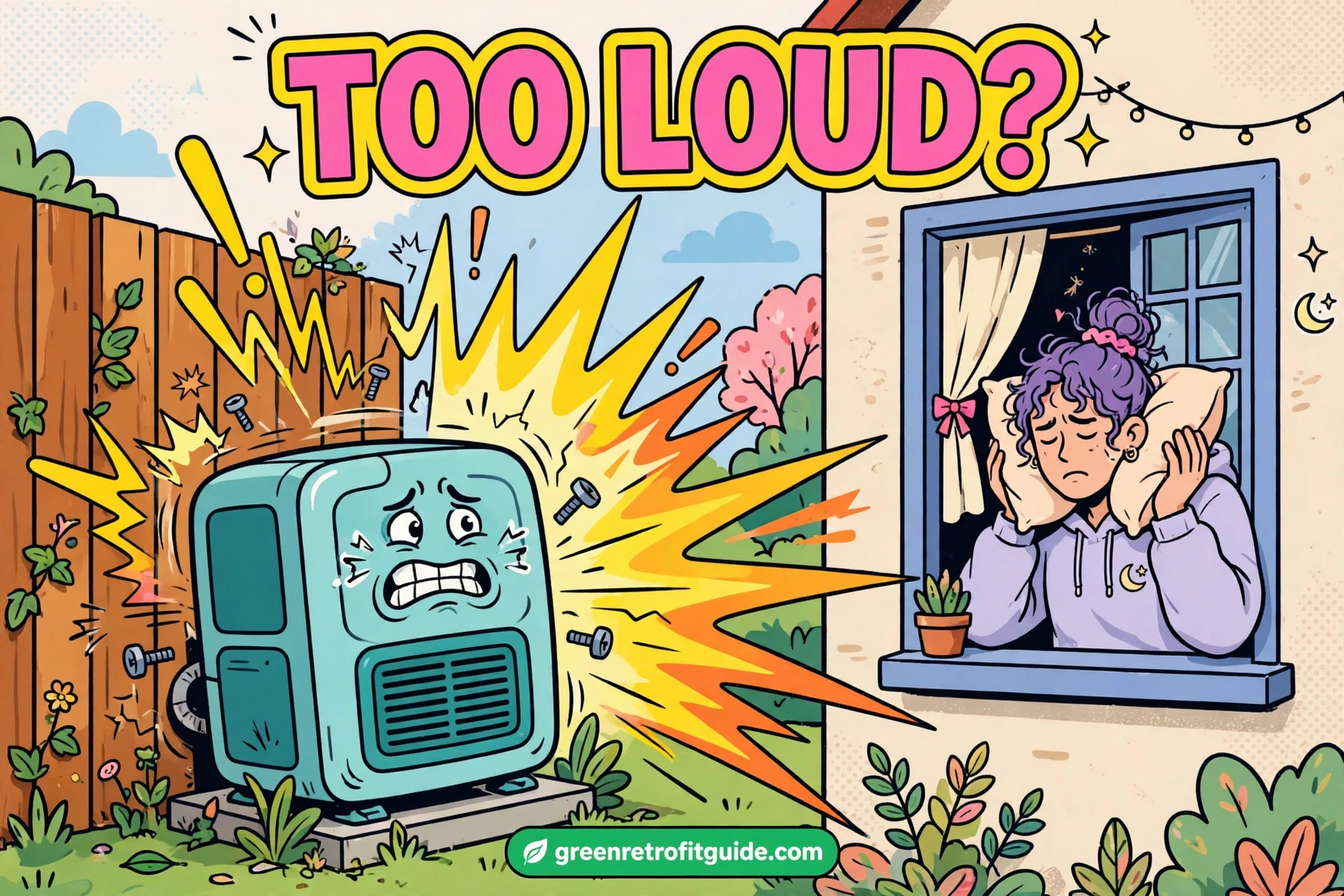
My Neighbour’s Heat Pump Is Making a Lot of Noise. What Should I Do?
Short answer: Why is my neighbour’s heat pump noisy? Start with a polite conversation with your neighbour, then keep a short noise diary. Many noisy heat pumps are fixed by a service, a quiet mode setting, or new anti-vibration mounts. If talking does not work, your council’s environmental health team can investigate whether the noise counts as a statutory nuisance. You do not have to live with a unit that keeps you awake, and you do not have to start with a formal complaint either.
A heat pump is not silent. It has a fan, a compressor, and moving air, so a steady hum is normal. The question is not whether you can hear it at all. It is whether the sound is normal for a well installed and well maintained unit, whether it breaks the planning rules that applied when it was installed, and whether it interferes unreasonably with your use of your home. Those are three different tests, and mixing them up is where most neighbour disputes go wrong.
What normal heat pump noise sounds like
A healthy air source heat pump usually makes a low, steady fan sound. It often gets louder in cold weather, because the unit has to work harder to draw heat from cold air. That change with workload is normal. In winter you may also hear a short defrost cycle: the fan pauses, there is a click or a whoosh, and steam rises from the outdoor unit for a few minutes while frost melts off the coil. That cycle is designed in, not a fault, and it repeats as needed in cold, damp conditions.
What should make you pay attention is a change. A unit that was once a background hum and is now rattling, grinding, or buzzing has usually developed a fault or a loose fitting. A new noise that appears suddenly, a noise that is much louder at night, or vibration you can feel through a wall are all worth raising, even if the unit passed its original planning calculation.
Sounds that point to a fault, not just a loud unit
You do not need to diagnose the unit yourself, and you should not open or touch a neighbour’s heat pump. But describing the sound accurately helps both your neighbour and, later, a council officer. Useful distinctions include:
- Rattling or buzzing panels: often a loose service cover or screws working free with vibration. This is one of the most common and cheapest fixes.
- Rhythmic clicking or ticking: often debris or ice in the fan, or a fan blade striking something it should not touch.
- Grinding, screeching, or a high pitched whine: often worn fan motor bearings or another moving part on its way out. This needs a technician, and running the unit on can make the repair bigger.
- Banging on start up or shut down: sometimes part of a defrost cycle, sometimes a loose panel or mount. If it is new and repeated, it is worth a service check.
- Vibration through a wall or floor: often worn isolation pads, a unit that is no longer level, or mounting that transmits vibration into the building structure. Neighbours often notice this before the owner does, because the owner hears the air sound while the neighbour feels the structure sound.
- Hissing or gurgling from pipework: can point to a refrigerant issue. That is a job for a qualified technician, not a home fix.
If you can, note when each sound happens. A fault that only appears on cold nights, or only when the unit starts up, tells a technician far more than “it is loud”. Keep that detail for the diary described below.
The 37 decibel rule, explained in plain English
In England, most domestic air source heat pumps are installed under permitted development, which means no full planning application is needed if the installation meets a set of conditions. One of those conditions is noise, assessed under the Microgeneration Certification Scheme planning standard MCS 020(a).
Under the current version of that standard, the calculated sound level must be 37.0 dB(A) or lower at every assessment position. An assessment position is a point one metre outside the centre of a door or window serving a habitable room on a neighbouring property. Habitable rooms are rooms used for living or sleeping, not bathrooms, hallways, or utility rooms. The calculation uses the manufacturer’s sound power figure for the specific unit, the distance to each assessment position, the number of nearby reflecting surfaces, and any barrier in between. It is a paper calculation done before installation, not a measurement taken in your garden afterwards.
Two common misunderstandings are worth clearing up. First, older guidance quoting 42 dB(A) is superseded: the current MCS 020(a) figure is 37.0 dB(A). If a neighbour, installer, or web page quotes 42 dB(A) as the current limit, it is out of date. Second, England removed the old rule that a heat pump must sit at least one metre from the property boundary in May 2025. A unit can now sit closer to a boundary and still be compliant, provided the sound calculation passes. The limit is acoustic, not geometric: what matters is the calculated level at your window, not the distance to your fence.
Other permitted development conditions in England include a size limit of 1.5 cubic metres for the unit on most houses, and a limit of one unit, except that detached houses can have two. The rules in Scotland, Wales, and Northern Ireland differ, so if you live outside England, check your own council’s planning pages rather than assuming the English figures apply. The same applies to listed buildings and some conservation areas, where permitted development may not apply at all.
Finally, planning compliance and nuisance law are different tests. A unit can pass its MCS 020(a) calculation and still be investigated by environmental health if, in practice, it causes a statutory nuisance. Passing the planning calculation is not a shield against a nuisance complaint, and failing it does not automatically prove a nuisance either. Keep both ideas in mind as you work through the steps below.
Step 1: Talk to your neighbour first
This is the step people most want to skip, and it is the step that most often works. Many heat pump owners have no idea their unit is disturbing anyone. They hear it from inside their own home, behind their own walls, while you hear it from your bedroom window or garden. A calm, specific conversation can fix the problem in a week, while a formal complaint can take months and sour a relationship that has to last far longer than any repair.
Be specific and practical. Instead of “your heat pump is too loud”, try something like: “Since last month we have been hearing a rattling sound from the outdoor unit most nights after 11pm, loudest in our back bedroom. Has it had a service recently, and does it have a quiet mode for overnight?” That gives your neighbour something to act on, and it shows you have noticed a pattern rather than reacting to a single noisy evening.
Useful things to ask about, without demanding any particular fix, include:
- Whether the unit has a quiet or night mode, and whether it is switched on. Many units can run at reduced power overnight.
- Whether the installer set a night setback or schedule, so the unit is not working at full power through the night.
- When the unit was last serviced, and whether the installer is MCS certified. A service can catch loose panels, worn mounts, and debris before they become a dispute.
- Whether the installer left an MCS 020(a) noise calculation. If your neighbour has it, it shows what level was predicted at your windows, and it gives an installer something concrete to recheck if the unit has got louder since.
If a face to face conversation feels difficult, or it does not work, put the same points in a short, polite letter or email and keep a copy. A written record matters if you later need to show a council that you tried informally first. Keep the tone factual: dates, sounds, times, and effects, not accusations about motive.
Step 2: Fixes worth asking about
You cannot fix a neighbour’s heat pump yourself, and you should not try. But it helps to know which fixes are realistic, so you can judge whether a proposed solution is serious or a brush off.
A service visit. This is the single most useful first fix for a unit that has got louder. A technician can tighten panels, clear debris, check fan bearings and mounts, and confirm the unit is running as designed. If the noise is new, a service is the obvious place to start, before anyone talks about moving or screening the unit.
Quiet mode and scheduling. If the unit has a quiet mode or a night schedule, using it can cut overnight noise without leaving anyone cold. Ask whether the setting exists and is actually switched on, rather than assuming it is. A setting buried in a menu helps nobody. Night scheduling also affects bills: our guide to whether it is cheaper to leave a heat pump running explains why setback beats switching the unit off.
Anti-vibration mounts and pads. Heat pumps sit on rubber or composite pads that absorb vibration. Those pads compress and wear over time, especially where a unit sits on a deck or above ground level. Worn pads let vibration travel into walls and floors, which is exactly the kind of noise neighbours feel rather than just hear. Replacing pads is a technician job, but it is far cheaper and simpler than moving a unit.
An acoustic screen or enclosure. Screens can help, but only if they are designed for the unit. A home made box, a fence panel jammed against the unit, or anything that blocks airflow can make the unit work harder, get louder, and even overheat. Any screen should be agreed with the installer, with clearances kept as the manufacturer requires. Do not build anything against a neighbour’s unit without their agreement and installer advice.
Moving the unit. This is the last resort, not the first ask. Moving a heat pump means new pipework, new electrical work, a new noise calculation, and possibly a planning application. It is sometimes the right answer where a unit was badly sited, for example boxed into a corner that reflects sound straight at a bedroom window, but it is a major job and it should follow a service check and a proper noise assessment, not replace them.
Step 3: Keep a noise diary
If talking does not fix the problem, start a diary before you contact the council. Councils ask for this because a single complaint of “it is loud” gives an officer very little to investigate. A diary gives them dates, patterns, and effects, and it gives you a record that is far more persuasive than memory.
For each disturbance, note:
- The date and the start and end time.
- What the noise sounded like: hum, rattle, grind, buzz, vibration, or a combination.
- Which room it affected, and whether windows were open or closed.
- What it stopped you doing: sleeping, working, using the garden, or holding a conversation.
- Anything relevant about conditions, such as a cold night when the unit was working hard.
Phone recordings and noise app readings can support a diary, but treat them as a record, not as proof on their own. Councils usually rely on an officer witnessing the noise or on calibrated monitoring equipment, and smartphone readings are not always accepted as formal evidence. That does not make your diary useless: it tells the officer when to visit and what to listen for, which is often the difference between a visit that catches the problem and one that does not.
Keep the diary factual and regular. Two weeks of consistent entries is a common starting point for councils, and a longer diary is stronger than a longer complaint letter. Do not record private conversations, and do not share recordings on social media: record the noise itself, and keep the material for the council or for legal advice.
Step 4: Complain to your council’s environmental health team
If informal steps have not worked, report the noise to your local council’s environmental health team. You can usually find the reporting form on your council’s website by searching for noise complaints and entering your postcode. You will normally need to give your name and address: councils do not usually investigate anonymous complaints, although your details are normally kept confidential at the early stages.
An officer will usually try informal resolution first, for example by writing to your neighbour or arranging a discussion. If that does not work, the officer can investigate whether the noise amounts to a statutory nuisance under the Environmental Protection Act 1990. That test looks at factors including how long the noise lasts, how often it happens, what time of day it happens, how it affects you, and what is reasonable in that neighbourhood. There is no single decibel figure that decides a statutory nuisance case on its own: the effect on you matters, not just a number on a meter.
If the officer is satisfied a statutory nuisance exists, the council can serve an abatement notice requiring your neighbour to stop or reduce the noise, which can include restricting the times the unit runs or carrying out works to quieten it. Ignoring an abatement notice is a criminal offence, and fines of up to £5,000 can follow for domestic premises. If you are unhappy with how the council handled your complaint, you can use the council’s formal complaints procedure, and then raise it with your local councillor or the Local Government and Social Care Ombudsman if the council did not follow its own process.
Be realistic about timescales. Council investigations vary widely, and a case that needs monitoring visits can take several months, especially where the noise is intermittent or only happens at night. Mediation is also worth asking about: many councils offer it, and a mediated agreement on quiet hours or a service date can be faster and less damaging than a formal notice.
Step 5: Private action, as a last resort
If the council will not act, or its investigation does not resolve the problem, you have a further route: under section 82 of the Environmental Protection Act 1990, you can take your neighbour directly to the magistrates’ court yourself. You would need your diary, witness evidence, and ideally a professional noise assessment, and you should take legal advice before starting, because costs and outcomes are not guaranteed. This is a serious step, and it is worth treating it as one: most disputes that reach this stage would have been cheaper and quicker to settle at the service or mediation stage.
Before you take that step, ask yourself honestly whether you have given the informal route a fair chance, and whether your evidence shows a pattern rather than a bad week. Courts, like councils, are persuaded by consistent records and reasonable attempts to resolve the problem, not by the strength of feeling alone.
What not to do
A few actions feel satisfying in the moment and make everything harder afterwards. Do not switch off, cover, or otherwise interfere with a neighbour’s heat pump: it is their property, and interfering with it can damage the unit and your case. Do not build a screen or fence against it without agreement and installer advice, because restricted airflow can make the noise worse. Do not retaliate with noise of your own. Do not record conversations without thinking about the law, and do not post recordings or accusations online. Every one of these steps turns a fixable heating problem into a neighbour dispute, and disputes are far harder to settle than fan bearings.
If you are the heat pump owner
If a neighbour raises noise with you, the same steps work in reverse. Ask what they hear and when, check whether quiet mode and night scheduling are switched on, and book a service if the unit has got louder. Keep your installer’s MCS 020(a) calculation and service records somewhere you can find them: they answer most questions before they become complaints. If a screen or repositioning is suggested, get installer advice first, and keep airflow clearances intact. A quick, visible response to a first complaint usually ends the matter, while silence lets a small fault grow into a formal case.
If you are weighing up a heat pump of your own, the money deadlines matter as much as the noise rules: read whether the Boiler Upgrade Scheme will be cut in the Autumn Budget and when 0% VAT on heat pumps ends before you commit to a date.
The order that works
Talk first, with specifics. Ask about a service, quiet mode, and mounts. Keep a diary if that does not work. Then go to environmental health with a record they can act on, and consider mediation before formal action. Check the planning position along the way: the current MCS 020(a) limit in England is 37.0 dB(A) at your habitable room windows, but a planning figure alone does not decide whether a noise is a statutory nuisance. Work the steps in order, keep records, and give each step time to work. That is how most neighbour heat pump noise problems actually get fixed.
Related reading
Will the Boiler Upgrade Scheme Be Cut in the Autumn Budget?
When Does 0% VAT on Heat Pumps End?
Is It Cheaper to Leave a Heat Pump Running?
Sources
Bracknell Forest Council, Air source heat pumps: permitted development conditions including the 37 dB(A) MCS noise condition. https://www.bracknell-forest.gov.uk/planning-and-building-control/planning/planning-applications/air-source-heat-pumps
Baxi, Do you need planning permission for a heat pump: the 37 decibel MCS 020 measurement and the removal of the one metre boundary rule. https://www.baxi.co.uk/help-and-advice/faqs/need-planning-permission-air-source-heat-pump
UKEM Group, MCS 020 Noise Assessment and Planning Standard: how the MCS 020(a) calculation works and the 37.0 dB(A) ceiling. https://www.ukem.co.uk/heat-pumps/news/mcs-020-heat-pump-planning-standard/
Problem Neighbours, Your Neighbour’s Heat Pump Is Too Loud: What Are Your Rights: talking to your neighbour, council complaints, noise diaries, and abatement notices. https://www.problemneighbours.co.uk/your-neighbour-s-heat-pump-is-too-loud-what-are-your-rights.html
Newcastle City Council, Statutory nuisance: how councils investigate noise complaints and what complainants need to provide. https://www.newcastle.gov.uk/services/environment-and-waste/environmental-health-and-pollution/statutory-nuisance
Problem Neighbours, Your Rights Under Noise and Statutory Nuisance law: section 82 private action in the magistrates’ court. https://www.problemneighbours.co.uk/rights-under-noise-and-nuisance-act.html
Frequently asked questions
How loud can my neighbour’s heat pump legally be?
Under the current MCS 020(a) planning standard in England, the calculated sound level must be 37.0 dB(A) or lower at a point one metre outside the centre of a door or window serving a habitable room on a neighbouring property. Older guidance quoting 42 dB(A) is superseded.
Can I complain if the heat pump passed its planning calculation?
Yes. Planning compliance and statutory nuisance are different tests. A unit can pass its MCS 020(a) calculation and still be investigated by environmental health if, in practice, it causes a statutory nuisance.
What is the first step if my neighbour’s heat pump is noisy?
Talk to your neighbour first, with specifics: what you hear, when you hear it, and which room it affects. Ask about quiet mode, night scheduling, and when the unit was last serviced, then put the same points in writing and keep a copy if the conversation does not fix it.
How do I keep a noise diary that a council can use?
Note the date, start and end time, what the noise sounded like, which room it affected, and what it stopped you doing. Keep entries factual and regular over at least two weeks. Phone recordings support a diary but are not usually accepted as formal evidence on their own.
How long does a council noise complaint take?
It varies widely by council and by how intermittent the noise is. An officer usually tries informal resolution first, then may visit or install monitoring equipment. Cases that need monitoring can take several months.
Can the council make my neighbour remove the heat pump?
The council can serve an abatement notice requiring the noise to be stopped or reduced, which can include restricting running times or carrying out works. Removal is a possible outcome where nothing else abates the nuisance, but it is not guaranteed, and ignoring an abatement notice is a criminal offence.
Why is my neighbour’s heat pump noisy?
Why is my neighbour’s heat pump noisy? A loose panel, worn mounts, or a fan fault are common causes, so start with a service check and quiet mode, as described above.

Related Posts
How Far Away Can You Hear a Heat Pump?
What Counts as Unreasonable Noise From Neighbours in the UK?