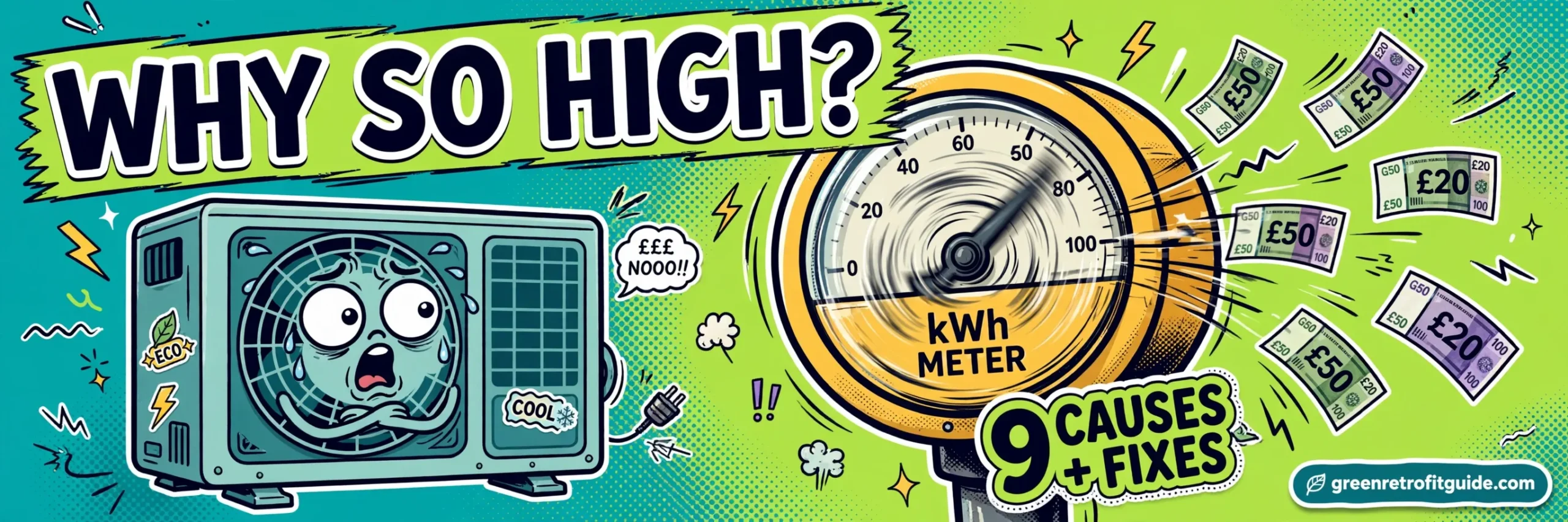
Why Is My Bill So High With a Heat Pump? 9 Causes and Fixes
Short answer: your heat pump is probably not broken. The Energy Saving Trust says heat pump problems in UK homes usually come from how the system is set up and how you use it, not the machine itself. The most common reasons for a high bill are a standard electricity tariff, a heating curve set too high, radiators that were never upgraded, short sharp heating bursts, and heat leaking out of the house. Work through the nine causes below, starting with the cheapest fixes first.
1. You replaced a very efficient boiler, so the maths was never in your favour
Electricity costs around four times as much as gas, according to the Energy Saving Trust. A typical new gas boiler runs at about 85% efficiency, while an older boiler due for replacement manages more like 75%. A heat pump with a seasonal performance factor (SPF) of 3.1 produces roughly four units of heat for each unit of electricity, so at current prices it costs about the same to run as a gas boiler.
If you replaced an old, inefficient boiler, your bill should be down. If you replaced a modern condensing boiler, expect costs to land about level unless you push the system’s efficiency higher. That is not a fault; it is arithmetic. And it sets up everything else in this article: the lever that changes the equation is lifting your SPF from 3.1 toward 4 or more, which the Energy Saving Trust says a good-quality installation, managed well, can reach.
2. You are on the wrong electricity tariff
On standard tariffs, the Energy Saving Trust says heat pumps can cost slightly more to run than new gas or oil boilers. The single biggest lever on your bill is a heat pump time-of-use tariff. Nesta commissioned energy consultancy Cornwall Insight to model this, and found that simply being on a flexible tariff saved heat pump users up to £600 a year compared with a standard tariff, without changing how they ran the pump at all. Several suppliers now offer dedicated heat pump tariffs with cheaper overnight electricity.
One warning: if your home still has an Economy 7 meter, get it changed. The Energy Saving Trust says Economy 7 meters do not work well with heat pumps, because the pump runs through the day on the expensive peak rate. And if you have removed your gas boiler and have no other gas appliances, ask about disconnecting the gas supply altogether. You stop paying the daily gas standing charge, which sits at 29.68p a day under the current price cap: around £108 a year for nothing.
3. Your heating curve is set too high
The heating curve, also called weather compensation, tells the pump what flow temperature to use at each outdoor temperature. If it is set too high, the pump works harder than it needs to all winter, and that feeds straight into the bill. The Energy Saving Trust’s efficiency guide warns that a wrongly set curve can increase your running costs, and notes that installers sometimes set it high just to make sure the house stays warm, when a much lower setting would do.
The fix costs nothing. Turn the curve down in one-degree increments through the winter. When the house starts to feel too cool, put it back up one degree and leave it there. The Energy Saving Trust says lowering the flow temperature can have a big impact on running costs, so this single setting is worth more than most of the gadgets people buy to cut their bills.
4. You run it like a gas boiler
A gas boiler suits short blasts of high heat: on full for an hour, then off. A heat pump is the opposite. It is most efficient running steadily, for longer, at lower flow temperatures. The Energy Saving Trust is explicit about this: trying to run a heat pump as though it were a gas boiler can lead to unexpectedly high electricity bills, poor comfort levels and even a higher risk of equipment failure.
Warning signs: radiators set to scalding, two furious heating sessions a day, the house swinging from hot to cold. The fix is to run longer and lower, use a small overnight set-back rather than switching off completely, and stop worrying that your radiators do not feel very hot. The Energy Saving Trust says lukewarm radiators will still heat the room if you leave them on long enough. Our guide to the most economical way to run an air source heat pump walks through the settings in full.
5. Your radiators were never upgraded
Heat pumps heat water to roughly 45C where a boiler ran at 75C, so radiators sized for a boiler can be too small to warm the room at the pump’s gentler temperatures. The pump then has to push flow temperatures up to compensate, and efficiency falls with them. The Energy Saving Trust lists radiators not being upgraded as one of the classic UK installation failings, and its advice is blunt: if your installer offers to upgrade your radiators and you want to avoid nasty bill surprises, say yes.
Check whether yours were upsized when the pump went in. If rooms never quite warm up unless flow temperatures are high, ask an installer about double or triple panel replacements, which give more surface area at the same wall space and let the system run at the low temperatures it was designed for.
6. Your hot water schedule is wasteful
Hot water holds two classic traps. First, the sterilisation cycle, which heats the cylinder above 60C periodically to keep legionella at bay. If it fires every day, or during the expensive peak, it burns money for no comfort gain. Second, reheating water whenever the cylinder feels low instead of at the cheapest or warmest part of the day.
The Energy Saving Trust’s advice covers both. On a time-of-use tariff, programme water heating for your cheapest electricity. With solar panels and a standard tariff, run it when the panels generate most. With a standard tariff and no solar, the middle of the afternoon is best: the outside air is warmest then, so the pump is at its most efficient. And make sure the sterilisation cycle runs in that same cheap window.
7. Your home leaks heat
A heat pump in a draughty house has to work harder all winter, whatever the settings. The Energy Saving Trust advises tackling insulation before or alongside a heat pump installation, and says the advice matters even more in older homes. Loft insulation top-ups, draught-proofing and cavity wall insulation all cut the heat demand the pump has to meet, and every kilowatt it does not have to produce is money saved.
There is funding to help: our guide to who qualifies for free insulation grants in 2026 maps the live schemes, including ECO4, which closes at the end of this year.
8. The outdoor unit is blocked
The pump pulls heat from the outside air, so it needs clear airflow around the outdoor unit. The Energy Saving Trust’s maintenance advice is simple: keep it clear of bikes, wheelie bins and leaves, because good air circulation helps the pump work more efficiently and reduces running costs. Walk outside and look. Clearing leaves and shifting the bins is the cheapest efficiency gain on this entire list.
9. The installation itself is faulty
This is the last resort, not the first suspicion. The Energy Saving Trust says that once a system is installed correctly, equipment failure is unlikely, and a heat pump should last 20 years or more. But its historical list of UK installation problems is worth knowing: systems not sized correctly, radiators not upgraded, narrow-bore pipework not replaced, and pipework not properly insulated.
Red flags that point at the installation rather than your settings: the immersion heater runs constantly, the system short-cycles on and off all day, rooms never reach temperature even with high flow temperatures, or bills jumped suddenly after months of working fine. Call your installer, or an MCS-certified engineer, and ask them to check sizing, pipework insulation and controls. Do not just accept “heat pumps are expensive to run” as the answer.
Quick diagnosis checklist: do this today
- Check your tariff: are you on a heat pump time-of-use tariff, or still on a standard rate?
- Nudge the heating curve down one degree and live with it for a few days.
- Confirm when your hot water and sterilisation cycle are programmed to run.
- Walk outside: is the outdoor unit clear of bins, bikes and leaves?
- Were your radiators upsized when the pump was installed?
- If bills jumped suddenly, call the installer rather than adjusting settings.
Why is my heat pump bill so high? Frequently asked questions
Why is my electricity bill so high after getting a heat pump?
Most often it is the setup, not the machine. The usual causes are a standard electricity tariff, a heating curve set too high, radiators that are too small, boiler-style usage patterns, or heat leaking out of the house. The Energy Saving Trust says performance problems are most likely to come from how the system is set up and how you use it, so work through the nine causes above before assuming anything is broken.
How much should a heat pump cost to run in the UK?
At a seasonal performance factor of 3.1, roughly the same as a gas boiler at current prices. Above an SPF of 4, it should undercut even efficient gas systems, according to the Energy Saving Trust. Tariff choice alone can shift the bill by up to £600 a year, based on Cornwall Insight modelling commissioned by Nesta.
Is it cheaper to leave a heat pump running all day?
Not flat out, but running steadily at lower temperatures for longer is more efficient than short hot blasts. The Energy Saving Trust says leaving the pump on for longer does not raise overall costs, because the efficiency gain offsets the longer running period. See our economical running guide for the full detail.
What is the best electricity tariff for a heat pump?
A heat pump time-of-use tariff with cheap off-peak electricity. The Energy Saving Trust warns against Economy 7 meters, which do not work well with heat pumps because the pump runs through the day on the expensive peak rate. If you have no gas appliances left, disconnecting the gas supply saves the daily standing charge too.
Do heat pumps use more electricity in very cold weather?
Yes. As the outdoor temperature falls, the pump works harder to extract heat and its efficiency drops. That is physics, not a fault. The tariff you are on and the settings above matter most during cold snaps, which is when a bad setup shows up on the bill.
When should I call my installer about high bills?
Call if the immersion heater runs constantly, the system short-cycles on and off all day, rooms never reach temperature even at high flow temperatures, or bills rose suddenly after working fine. Ask for a check of system sizing, pipework insulation and controls, and do not accept “heat pumps are expensive to run” as a diagnosis.
Sources
- Energy Saving Trust, “Your heat pump questions answered by our experts” (updated 27 May 2026): energysavingtrust.org.uk/heat-pump-questions-answered
- Energy Saving Trust, “The most efficient way to run a heat pump” (updated 19 May 2026): energysavingtrust.org.uk/how-to-ensure-a-heat-pump-runs-efficiently
- Energy Saving Trust, “Ofgem’s energy price cap explained” (October to December 2026 rates: electricity 26.32p per kWh, gas 7.97p per kWh): energysavingtrust.org.uk/what-is-the-energy-price-cap
- Nesta, “Can time-of-use tariffs make heat pumps cheaper to run?” (Cornwall Insight modelling: up to £600 a year saving on a flexible tariff): nesta.org.uk/blog/can-time-of-use-tariffs-make-heat-pumps-cheaper-to-run

Related Posts
How Far Away Can You Hear a Heat Pump?
What Counts as Unreasonable Noise From Neighbours in the UK?